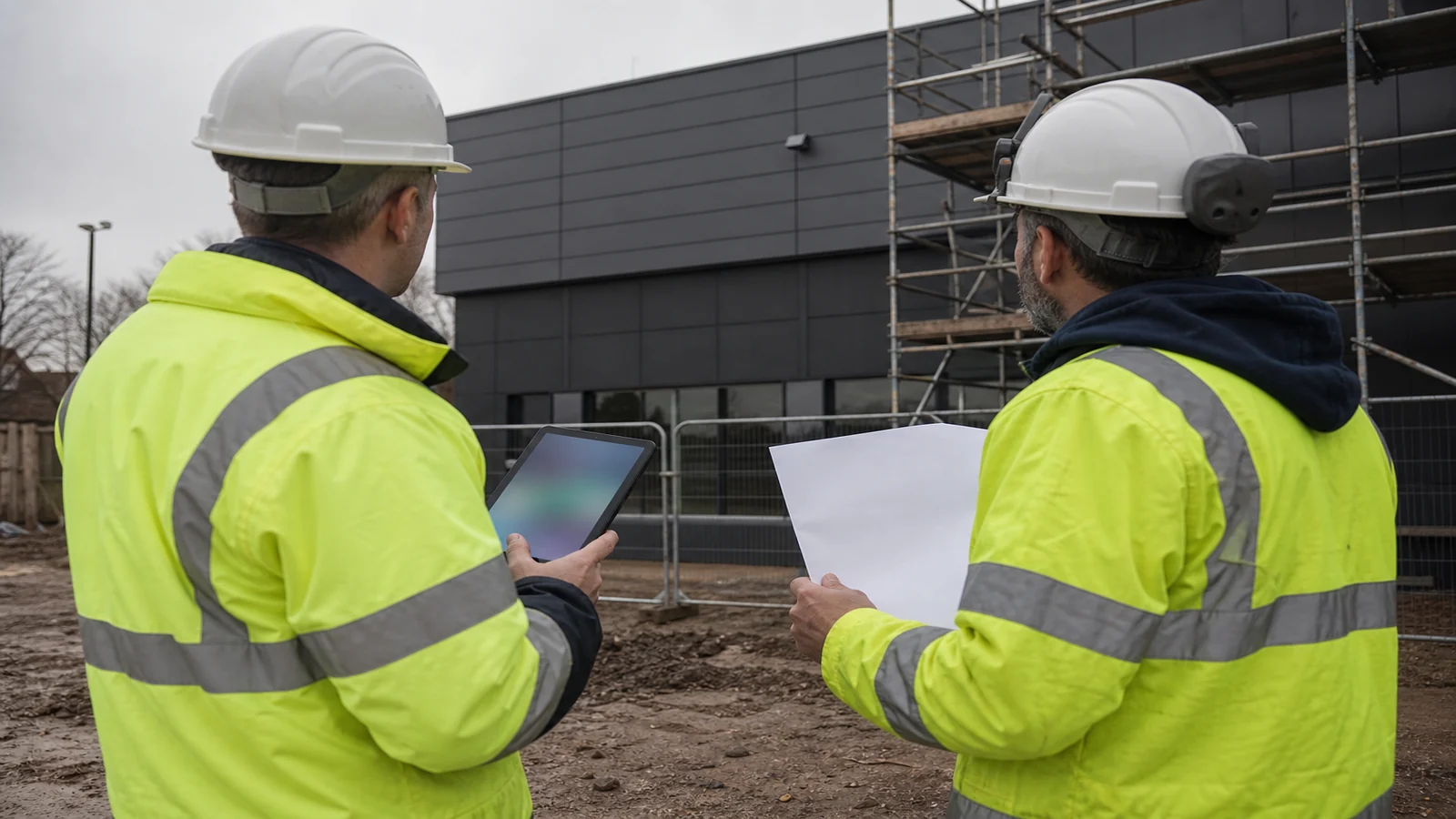
Time Lapse Camera Installation Risk Assessment UK: What the Site Team Must Decide
The site team must decide who owns the camera installation risk assessment, whether the unit can be installed and later serviced from ground level, and which conditions mean the job stops. A time-lapse camera is not a trivial add-on when the mount, the access, or the falling-object path can hurt someone. This page is a decision sequence for contractors and clients. It is not a completed risk assessment and it does not give legal certainty beyond the official guidance it cites.
Who should own the camera installation risk assessment
Ownership sits with the employer or self-employed contractor who will create the risk, not with the person who asked for a nice progress film. HSE’s page on assessing all work at height is explicit: employers and self-employed contractors must assess the risks, decide on the precautions, record the significant findings, and review the assessment. If installing or later reaching the camera involves a fall from height, that duty is already in play, even if the camera itself is small.
On a CDM site, the principal contractor still has to make the construction phase plan and the site rules mean something for visitors. The camera supplier can provide information about the housing and the manufacturer’s intended mounting. The supplier cannot sign away the site’s duty to plan the access. Name a dutyholder who can stop the job, and name the competent person who will write the method if the hierarchy of control cannot keep the task at ground level.
If the client wants a viewpoint that only exists above a live area, the client is asking for a construction task, not a photography favour. Put that in the assessment as a design choice: change the view, change the programme so a safe platform already exists, or resource a proper access package. Do not leave ownership as “the cameraman will sort it”.
Can the camera be installed and serviced from ground level
Work through the hierarchy before choosing equipment. HSE’s work-at-height guidance says the hierarchy must be followed systematically, and only when one level is not reasonably practicable may the next be considered. The first question is not “which ladder?”. It is “can we avoid work at height?”.
- Avoid: choose a viewpoint that can be installed, aimed, cleaned, and removed from the ground or from an existing place of work that already has permanent edge protection.
- Prevent, collective: if height cannot be avoided, use a place of work that protects everyone, such as an independent scaffold or another platform already in the site plan with guard rails.
- Prevent, individual: only then consider equipment that protects one person, and only inside a planned method.
- Mitigate: fall arrest and similar measures sit further down the hierarchy. They are not a shortcut for a camera that could have been mounted lower.
Ground-level is the default pass. If a post, a hoarding return, or a plant-room door gives the agreed elevation, take it even if the photograph is slightly less dramatic. A camera that needs a weekly climb is a repeating work-at-height activity, not a one-off install. Count the service visits in the assessment, not only the first afternoon.
HSE also expects method statements where they help people understand the hazards and the precautions. For a camera, a short statement that names the mount, the exclusion zone, the dropping-object control, and the stop conditions is more useful than a generic “install CCTV” paragraph copied from another job.
When is a ladder unsuitable for the task
A ladder is not the starting point. HSE’s guidance on when and how to use ladders safely says ladders can be used for work at height when a risk assessment has shown that equipment offering a higher level of fall protection is not justified, because of low risk and short duration, or because existing workplace features cannot be altered. Short duration is not the deciding factor on its own: you must first consider risk.
As a guide, if the task would require staying up a leaning ladder or stepladder for more than 30 minutes at a time, HSE recommends alternative equipment. Aiming, testing, and waiting for a sample frame often takes longer than people admit. If the installer needs both hands, a laptop, a long stay, or a position that is not level and stable, a ladder is the wrong tool.
Use a ladder only where it can be used safely: level, stable, and secured where that is reasonably practicable, by someone who is competent or supervised. Do not use a ladder because the scaffold is “nearly there”, because the client is watching, or because the only tidy view is from a stairwell with a poor footing. If those are the real reasons, the assessment has already failed and the viewpoint must change.
How should falling objects and unauthorised access be controlled
A housing, a clamp, a battery box, and a tool are all falling objects if they are taken above other people. Control them as you would any other small item of plant:
- Keep the work in an exclusion zone, or do it when the area below is already closed by the site’s traffic and pedestrian plan.
- Use a mount the temporary-works or site management has accepted. Do not hang the camera from a handrail, a lifting beam, or a scaffold tube that was not offered for that load.
- Tether tools. Do not leave loose lids, cards, or housings on a platform edge.
- Route cables so they cannot snag a load or become a ligature on a walkway.
Unauthorised access is both a safety and a data issue. If members of the public, other trades, or an unbriefed visitor can reach the camera, they can drop it, turn it, or take the store. Put the unit inside the hoarding line where possible. Record who may approach it. HSE’s site rules and induction page expects restricted areas, permit-to-work systems where used, and inductions that are proportionate even for occasional visitors. A camera visit is not exempt because it is “only pictures”.
What privacy points belong in the assessment
Privacy is part of the same decision, not a later admin email. The ICO’s guidance on how to comply with data protection principles when using surveillance systems asks organisations to consider whether a less intrusive method would achieve the purpose, to focus the camera on a relevant space, and to restrict wider surveillance that is possible but unnecessary. A progress camera that also covers a neighbouring dwelling, a pavement, or an area where people have a heightened expectation of privacy is a different system from a camera that only sees the building plot.
Record in the assessment:
- the purpose in one sentence, and what the camera will not be used for;
- whether people will be identifiable as more than incidental site activity;
- whether audio is off;
- how people will be told that recording is taking place, who operates it, and how to ask a question;
- who may view and copy files, how they are stored, and when they will be deleted.
If the only mount that “works” looks into homes, the privacy control is to move the camera, not to promise that “nobody will look at that bit”. Purpose limitation is not a crop in an editor three months later.
What conditions mean the job must stop
Stop when the viewpoint cannot be reached without creating work at height that has not been assessed and resourced. Stop when a ladder would be used because it is convenient, not because the assessment has shown higher protection is not justified. Stop when people below cannot be kept out of the dropping zone. Stop when the installer has not had a suitable induction. Stop when the view cannot be limited to the stated purpose. Stop when nobody on site can name the dutyholder.
Workers should know what to do if the method needs to change. That sentence is the point of a method statement. A camera job that becomes “we’ll just clip it a bit higher” in the rain is a new task. It needs a new decision, not optimism.
Diagnostic ladder for the installation decision
- Name the task and the dutyholder. If you cannot, do not go to site with tools.
- Ask whether height can be avoided. If a ground-level or already-protected place of work gives a usable progress view, take it.
- If height remains, pick collective protection that already exists in the plan before personal equipment, and before a ladder.
- Test the ladder question last, against HSE’s conditions of low risk, considered duration, competence, and a level, stable, securable position. A long aiming session fails this test.
- Add falling-object, cable, and unauthorised-access controls as significant findings, not as footnotes.
- Add privacy purpose, view limits, signage, and file handling before the first live interval.
- Stop if any of those steps depends on improvisation, an uninducted visitor, or a view you cannot defend.
Who this article is not for
This article is not for readers who want a certificate, a completed RAMS pack, or legal certainty that a particular mount is acceptable. It is not written for DIY work on a live site without the principal contractor’s control. It is not a product specification sheet and it does not claim that any camera is safe to place at height.
Stop conditions
The job must stop when there is no named dutyholder, when work at height cannot be avoided and has no competent method, when a ladder is being used outside the conditions in HSE’s ladder guidance, when people below are exposed to falling objects, or when the camera cannot be limited to a purpose-justified view. Do not trade a progress film against an unplanned climb.
If a ground-level mount is the remaining choice
If the assessment has already selected a viewpoint that can be installed and serviced without a new climb, and you still need a compact unit for that approved position, you can review the construction time-lapse camera product page. Match the live listing and the manufacturer’s mounting instructions to the method the site has already accepted. This article does not approve a height, a clamp, or a weather rating.