The Ultimate Guide to Time Lapse Cameras: How to Choose the Best Cameras with Time Lapse for UK Projects
A practical buyer's guide comparing dedicated time lapse cameras against standard cameras with interval shooting features — focused on weatherproofing, durability, and long-term deployment for UK construction, nature monitoring, and outdoor projects in 2026.
What Are Time Lapse Cameras and Why Do They Matter?

Time lapse cameras capture images at set intervals — anywhere from every few seconds to once per hour — then stitch them into accelerated video showing days, weeks, or months of progress in minutes. They're used across construction sites, ecological surveys, garden projects, and infrastructure monitoring throughout the UK.
I've been using these on various council-related projects here in Belfast for a few years now. Honestly, the difference between a purpose-built timelapse unit and a bodged-together DSLR setup is night and day when you're deploying something for six months on a building site off the Antrim Road.
The UK market has shifted significantly in early 2026. We're seeing more affordable dedicated units with 4K resolution and genuine long-term battery life, which has changed the calculation for smaller projects that previously couldn't justify the spend.
So what's the catch? Well, actually, there isn't much of one anymore — prices have dropped while specs have climbed. But choosing wrong still costs you. A camera that dies after three weeks in Belfast rain isn't saving anyone money.
Dedicated Time Lapse Cameras vs Standard Cameras: Which Should You Pick?
Dedicated timelapse units are built from the ground up for unattended, long-duration recording. Standard cameras — DSLRs, mirrorless, action cams — can shoot intervals too, but they weren't designed to sit on a scaffold pole for half a year.
Dedicated Timelapse Units
These are the workhorses. Purpose-built interval cameras like those in the dsoonact range typically offer IP66 weatherproofing, battery life measured in months rather than hours, and simplified setup. No laptop needed on site. No complex menu diving.
The trade-off? Image sensor size is usually smaller than a full-frame DSLR. You won't get the same shallow depth of field or low-light performance. For documenting a build or tracking plant growth, though, that rarely matters.
Standard Cameras with Interval Features
A Canon 2000D or GoPro Hero can shoot timelapse. They'll give you superior image quality frame-by-frame. But here's the reality: you'll need external power, a weatherproof housing, an intervalometer, and someone checking on it regularly. I've seen setups like this fail within weeks on exposed sites.
My experience? For anything beyond a weekend project, dedicated units win on total cost of ownership. The upfront saving on a consumer camera evaporates once you factor in housings, power solutions, and site visits when something goes wrong.
UK Weather and Durability: What IP Rating Do You Actually Need?

The UK gets an average of 156.2 rain days per year according to Met Office data. In Belfast, where I'm based, we're well above that. Any camera deployed outdoors needs serious weather protection — this isn't optional.
Understanding IP Ratings
IP ratings have two digits. The first (0-6) covers solid particle protection. The second (0-9) covers liquid ingress. For UK outdoor deployment, you want minimum IP65. IP66 is the sweet spot for most projects.
- IP65: Dust-tight, protected against water jets from any direction
- IP66: Dust-tight, protected against powerful water jets — handles driving rain and hose-down
- IP67: Dust-tight, survives temporary immersion up to 1 metre
I know IP66 sounds like overkill for a camera. It isn't. Horizontal rain driven by 40mph winds — standard winter fare across Northern Ireland and much of Scotland — will find every gap in an IP54-rated housing. I've learned this the hard way. (Twice, if I'm being honest.)
Temperature Range Considerations
UK temperatures typically range from -10°C to 35°C across the year. Most dedicated timelapse units operate from -20°C to 50°C, giving comfortable headroom. Standard cameras with lithium batteries lose significant capacity below 0°C — sometimes 40-50% at -5°C. That's a real problem for winter deployments.
The Health and Safety Executive requires construction site monitoring equipment to function reliably in all weather conditions when used for safety documentation. Choosing a camera that fails in cold snaps creates compliance gaps.
Mounting and Wind Loading
Wind is the silent killer of outdoor camera deployments. A camera mounted at height on a construction site faces sustained winds of 50-70mph during winter storms. Vibration causes blurred frames and, worse, mounting failures. Dedicated construction timelapse cameras typically weigh under 500g and present minimal wind cross-section — a significant advantage over bulky DSLR housings.
Key Specifications That Matter for Long-Term Time Lapse Projects

Not all specs matter equally. Here's what actually makes a difference when you're deploying for weeks or months at a time.
Battery Life
This is the single most important spec for unattended deployment. Dedicated timelapse cameras achieve long battery life through ultra-low-power electronics that sleep between captures. The best units manage 4-6 months on internal batteries at one frame per 5 minutes — roughly 52,000-78,000 frames without intervention.
For comparison, a GoPro Hero in timelapse mode drains its battery in 2-3 hours. Even with an external battery pack, you're looking at weekly site visits. On a 12-month construction project, that's 50+ trips versus 2-3 battery swaps with a dedicated unit.
Resolution
4K (3840 × 2160) has become the standard for serious project documentation in 2026. It gives you enough detail to zoom into specific areas in post-production — useful when a client asks "what happened to that wall section in week 14?" Full HD (1920 × 1080) still works for general progress recording but limits your cropping options.
Interval Range
Different projects need different capture rates:
- Construction: 1 frame every 5-10 minutes (captures meaningful progress without massive file sizes)
- Nature/wildlife: 1 frame every 1-30 seconds (captures movement and behaviour)
- Plant growth: 1 frame every 15-60 minutes (daily changes visible without redundancy)
- Events: 1 frame every 1-5 seconds (smooth playback of crowd movement)
Storage Capacity
A 4K image averages 8-12MB depending on compression. At one frame per 5 minutes over 6 months, that's approximately 52,560 frames — roughly 420-630GB uncompressed. Most dedicated units use efficient JPEG compression bringing this down to 64-128GB for a typical deployment. Check maximum SD card support: 256GB minimum for long projects.
Connectivity
Some units offer WiFi or 4G for remote monitoring and image download. Brilliant for sites you can't easily access. Cellular connectivity does drain batteries faster, though — expect 30-50% reduction in battery life with daily uploads enabled. Worth it for critical projects; unnecessary for a garden timelapse., a favourite among Britain’s tradespeople
2026 Camera Comparison: Specs and Pricing for UK Buyers

Here's how the main options stack up this spring. I've focused on units actually available to UK buyers with realistic delivery times.
| Feature | Dsoonact 4K Timelapse Camera | Brinno TLC 2020 | GoPro Hero (Timelapse Mode) | Canon DSLR + Intervalometer |
|---|---|---|---|---|
| Price (approx.) | £148.56 | £220-£260 | £350-£400 | £500-£800+ |
| Resolution | 4K (3840×2160) | 1080p Full HD | 5.3K / 4K | Up to 24MP stills |
| IP Rating | IP66 | IPX4 (splash only) | IP68 (with housing) | None (needs external housing) |
| Battery Life (timelapse) | Up to 6 months | Up to 82 days | 2-3 hours | 4-8 hours (varies) |
| Purpose-Built for Timelapse | Yes | Yes | No (feature mode) | No (requires accessories) |
| Unattended Outdoor Use | Excellent | Good (needs shelter from heavy rain) | Poor (battery limits) | Poor (power + weather issues) |
| Setup Complexity | Low — plug and go | Low | Medium | High |
The numbers tell a clear story. For dedicated outdoor deployment, the Dsoonact 4K unit at £148.56 offers the best combination of resolution, weather protection, and battery life per pound spent. The Brinno TLC 2020 is a solid performer but only manages 1080p, and its IPX4 rating means you'll want some form of rain shelter in exposed locations.
Worth the extra spend on a GoPro or DSLR? Only if you need the superior image quality for commercial video production. For project documentation, progress reporting, and monitoring, the dedicated units are spot on.
Best Use Cases: Matching Your Camera to Your Project

Construction Site Monitoring
Construction is where time lapse cameras earn their keep. A single camera documenting a 12-month build creates invaluable records for client updates, dispute resolution, and marketing. The UK Government's construction guidelines increasingly reference visual documentation as best practice for project management.
For construction, you need: IP66 minimum, 4K resolution, 5+ month battery life, and secure mounting options. The dsoonact unit ticks all these boxes at a price point that makes multi-camera setups feasible — covering different angles of the same site without breaking the budget.
Nature and Wildlife Monitoring
Ecological surveys, nesting box monitoring, habitat change documentation — all benefit from long-term interval capture. Here, camouflage and minimal disturbance matter as much as specs. Smaller dedicated units with earth-tone housings work brilliantly. Set your interval to 10-30 seconds for wildlife activity, or 30-60 minutes for habitat change over seasons.
Garden and Allotment Projects
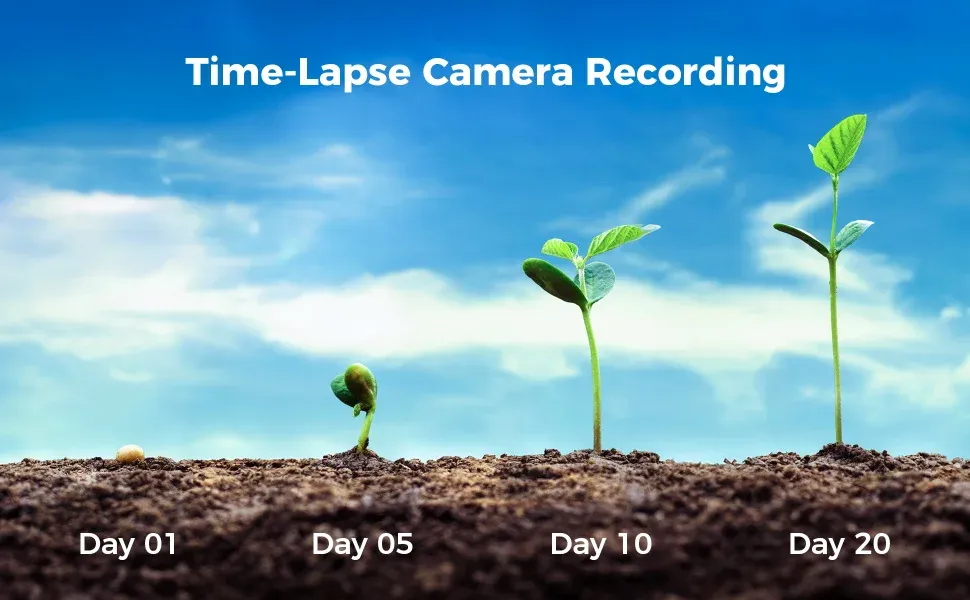
Honestly, this is where I started with timelapse photography. Watching a raised bed go from bare soil to full harvest in a 30-second clip never gets old. You don't need the most expensive kit here — but you do still need weather protection. Belfast weather doesn't care that your camera only cost £50.
Infrastructure and Renovation
Home renovations, road works, bridge repairs — any project where visual progress documentation helps with planning, client communication, or regulatory compliance. The British Standards Institution references visual documentation methods in several construction and infrastructure standards.
I'd recommend checking the Brinno comparison page on dsoonact.co.uk if you're weighing up options for a specific project type. They've broken down the use cases quite well there.
Frequently Asked Questions
How long do time lapse cameras last on a single battery charge?
Dedicated timelapse units last 2-6 months depending on capture interval and temperature. The Dsoonact 4K camera achieves up to 6 months at standard intervals. Cold weather (below 0°C) reduces this by 15-25%. Standard cameras like GoPros last only 2-3 hours in timelapse mode, requiring external power for any serious deployment.
What IP rating do I need for outdoor timelapse in the UK?
IP66 is the recommended minimum for fully exposed UK outdoor deployment. This protects against driving rain and dust ingress. IP65 works if the camera has partial shelter. IPX4 (splash-proof only) isn't sufficient for unattended use in exposed locations, particularly in western and northern regions where horizontal rain is common.
Is 4K resolution necessary for construction timelapse?
4K isn't strictly necessary but offers significant advantages. At 3840×2160 pixels, you can crop into specific areas during post-production without losing detail — useful for dispute resolution or focusing on particular work phases. Full HD (1080p) works for general progress videos but limits your flexibility. In 2026, 4K units like the Dsoonact camera cost under £150, making the upgrade easy to justify.
Can I use a GoPro as a long-term timelapse camera?
Not without significant modification. GoPro batteries last 2-3 hours in timelapse mode. You'd need external power (solar panel or mains), a weatherproof housing rated above IPX4, and regular SD card management. Total cost with accessories exceeds £500, and reliability remains lower than purpose-built units costing £148-£260. GoPros excel at short-duration event timelapses, not multi-month deployments.
How much storage do I need for a 6-month timelapse project?
At one 4K frame every 5 minutes over 6 months, expect approximately 52,560 images. With JPEG compression, that's roughly 80-128GB depending on scene complexity. A 128GB microSD card handles most 6-month projects comfortably. For 1-minute intervals or 12-month projects, use 256GB cards. Always format cards as exFAT for files larger than 4GB.
Do I need planning permission to install a timelapse camera on a UK construction site?
No planning permission is needed for temporary camera installations on construction sites you control. However, if the camera captures public areas or neighbouring properties, you must comply with UK GDPR and data protection regulations. Display signage indicating recording is in progress. Cameras pointed solely at your own site with no public-facing view have minimal regulatory requirements.
Key Takeaways
- Dedicated time lapse cameras outperform standard cameras for any unattended deployment longer than 48 hours — battery life alone makes the difference (6 months vs 2-3 hours).
- IP66 is the minimum weatherproofing standard for exposed UK outdoor use. IPX4 splash ratings aren't sufficient for unattended deployment in rain-heavy regions.
- 4K resolution at £148.56 (Dsoonact unit) represents the best value for UK buyers in 2026, undercutting competitors by £70-£250 while matching or exceeding weather protection specs.
- Battery life depends heavily on temperature and interval settings. Budget for 15-25% reduction in cold months. One frame per 5 minutes is the sweet spot for construction documentation.
- Total cost of ownership matters more than purchase price. A £350 GoPro needing weekly site visits costs more over 12 months than a £148 dedicated unit needing two battery swaps.
- Storage requirements are manageable: 128GB handles most 6-month 4K projects. Always carry a spare formatted card.
- Multi-camera setups are now affordable. Three Dsoonact units covering different angles cost less than a single professional DSLR timelapse rig.
Choosing Your Camera: The Practical Decision
After testing various setups across different projects — from council building works to my own allotment — I keep coming back to the same conclusion. For UK outdoor projects, dedicated timelapse units win on every practical measure except raw image quality. And unless you're producing broadcast-grade content, that image quality gap doesn't matter.
The dsoonact.co.uk range gives you a solid starting point. At £148.56 for a 4K, IP66-rated unit with 6-month battery life, you're getting specs that would have cost £400+ just two years ago. That's not marketing fluff — it's where the market has genuinely moved in 2026.
My advice? Match the camera to the project duration and exposure level. Short indoor project? Almost anything works. Six months on an exposed construction site in Antrim? You need IP66, long battery life, and secure mounting. Don't learn that lesson the expensive way like I did.
Get sorted with the right kit from day one, and your timelapse footage will take care of itself.
Ready to try Dsoon?
Shop Now — £128.58