Long-Term Time-Lapse Kits for UK Construction Sites
Plan a reliable UK construction time-lapse kit around purpose, position, interval, power, storage, weather, privacy and a realistic maintenance routine.
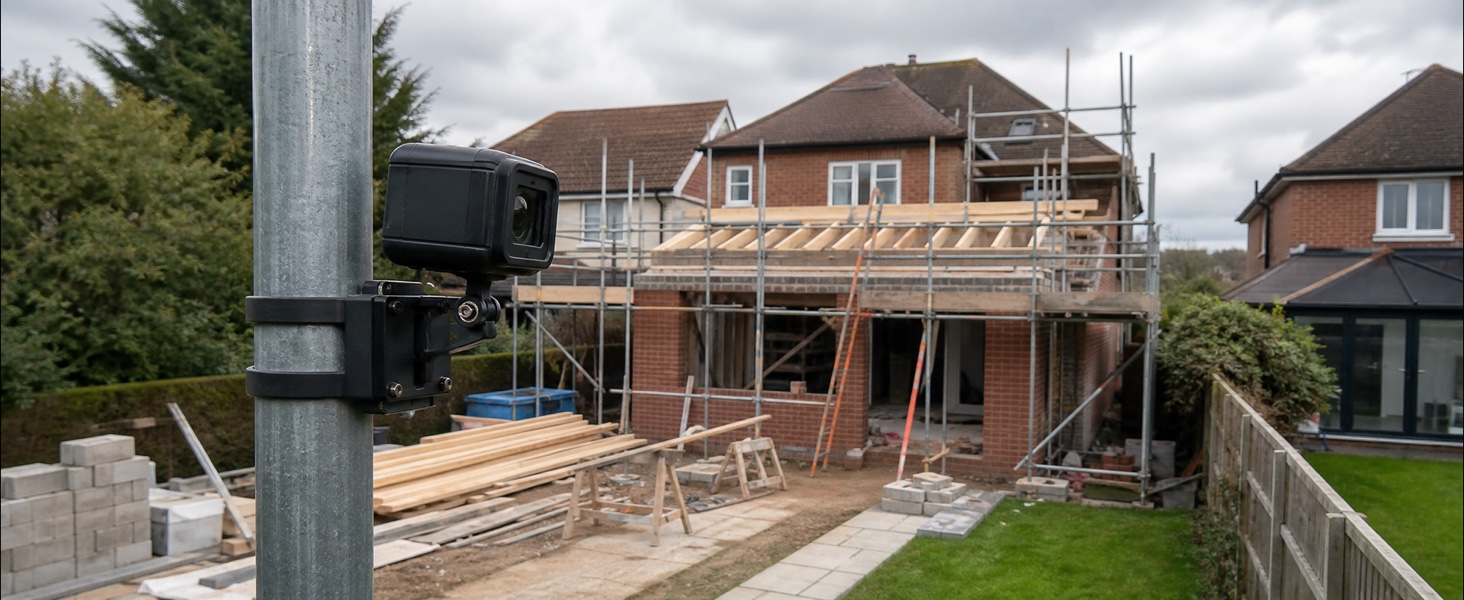
A construction time-lapse can compress months of work into a useful handover film, client update or project record. The camera is only one part of that result. Position, power, storage, weather protection, privacy, maintenance and post-production must continue working after the excitement of installation has passed.
A reliable construction time-lapse starts with the maintenance plan, not the resolution badge. Before buying a kit, decide who owns it, how often it will be checked and what happens when the build changes around it.
First decide what the footage is for
Different purposes require different coverage and retention.
| Purpose | What matters most | Common mistake |
|---|---|---|
| Client progress updates | Consistent overview and regular exports | Moving the camera for every interesting detail |
| Final marketing film | Stable composition, clean sequence and planned milestones | Discovering at handover that key stages were outside frame |
| Internal project record | Reliable dates, coverage and file management | Treating a creative time-lapse as formal site surveillance |
| Self-build memory film | Simple unattended operation and manageable edit | Choosing an interval that creates too much or too little material |
| Security or live monitoring | Different camera, network and governance requirements | Expecting an interval camera to replace CCTV |
An interval camera records selected frames. It is not automatically a live webcam, security system or evidential CCTV installation. If security is the goal, specify that as a separate system with appropriate monitoring and data-protection controls.
What a complete long-term kit needs
A purpose-built interval camera
Look for dependable scheduling, a clearly documented image or video format, a usable field of view and controls that can be locked after setup. 4K output can leave room for a final crop, but it cannot repair a poor viewpoint, water on the lens or weeks of missed frames.
Dsoonact currently lists the Dsoon 4K outdoor time-lapse camera. Its live page states 3840 x 2160 output, a 13MP sensor, IP66 housing, four-AA power, a 64GB TF card and a claimed operating range of -10 C to 50 C. It also describes “up to six months” battery life at interval recording. Treat that duration as a conditional product claim: interval, temperature, battery chemistry, playback and maintenance visits all affect real service life.
A rigid, repeatable mount
Small movement becomes a visible jump in the final film. Use a mount that cannot rotate in wind or loosen when nearby work vibrates. Mark the position and camera angle so a removed unit can be returned accurately. Avoid temporary fences, scaffold members that will be struck, and structures scheduled for demolition.
Read the building-site camera positioning guide before installation. Frame enough context to survive changes in scaffolding and material storage, but avoid unnecessary views of neighbouring homes or public areas.
Power with a service margin
Battery-only systems are simple, but the maintenance interval must be shorter than the proven battery interval. Test the exact camera, settings and battery type before trusting a months-long claim. Cold weather and frequent screen use can reduce runtime.
Where mains or solar power is considered, use equipment and installation methods appropriate to the site. Cables must not create trip, damage or water-ingress risks. A power source does not remove the need for periodic checks because storage, lens condition and mounting can still fail.
Storage sized from the capture plan
Estimate storage from four numbers: frames per day, average file size, project days and a reserve. For example, one frame every ten minutes during a ten-hour working day creates 60 frames per day; continuous 24-hour capture creates 144. Multiply by the tested file size rather than a brochure estimate.
Choose an interval using the construction-project interval guide. Shorter intervals suit fast activity but produce more files and editing work. Long intervals reduce storage but can miss brief stages.
Weather and lens management
An IP rating describes tested resistance under defined conditions; it does not mean the whole installation is maintenance-free. Keep seals clean, close covers fully and route the camera so water does not collect around openings. Check whether the mount remains secure after high wind.
Rain spots, condensation, dust and low winter sun can spoil the image while the electronics continue recording. Include lens cleaning and a sample-frame check in every visit. The seasonal daylight planning guide helps identify glare and changing shadow problems before they dominate the sequence.
Build the shot before fixing the camera
Visit the site with a phone or temporary camera and make test frames at different times of day. A strong position normally shows the work area, a stable reference such as an existing wall, and enough sky or ground to make progress understandable without wasting most of the frame.
Ask these questions:
- Will scaffolding, hoarding, a skip or a delivery vehicle block the view later?
- Is the camera likely to be moved by another contractor?
- Can it be reached safely for maintenance?
- Does the frame include neighbouring windows, gardens or a public footpath that are not needed?
- Can the mount remain in place through the final milestone?
- Is there a second approved position if the first structure is removed?
Create a simple construction time-lapse shot list for foundations, structure, roof, envelope, fit-out and completion. A fixed overview plus separately filmed milestone shots is often better than repeatedly moving the main camera.
Safety comes before the viewpoint
Installing or servicing a camera may involve work at height. HSE guidance says work at height must be properly planned and organised, carried out by competent people, and use suitable equipment selected from a risk assessment. It also says work at height should be avoided where reasonably practicable.
That means a dramatic roofline angle is not worth an unsafe installation. Prefer a location serviceable from ground level or a protected working position. Do not improvise a long camera task from an unsuitable ladder, lean out of an opening or attach equipment where it can fall onto people below. Coordinate access and isolation with the site manager.
The mount, camera and any secondary retention must be compatible with the structure. Recheck them when the site layout changes or after an event that could affect stability.
Privacy and worker expectations
Time-lapse footage can still contain personal data when people are identifiable. ICO guidance for video surveillance emphasises a clear purpose, a lawful basis, data minimisation, transparency, secure access and an appropriate retention policy. High-risk processing may require a data protection impact assessment.
For a construction project, practical controls include:
- frame only the area needed for the stated film;
- avoid neighbouring homes and public space where possible;
- tell workers and visitors what is being recorded and why;
- disable audio unless there is an exceptional, justified requirement;
- restrict access to original files;
- decide how long raw frames will be kept;
- avoid repurposing progress footage for worker performance monitoring;
- document who handles access requests or objections.
Use the site’s UK construction time-lapse privacy checklist as a starting point, then obtain appropriate advice for the actual project.
Commission the system before the real sequence
Run a short pilot before permanent installation:
- Set the date, time zone, resolution and interval.
- Fit the intended batteries and freshly formatted supported card.
- Secure the mount and capture a reference frame.
- Leave the camera for several normal working days.
- Inspect the lens, seals, mount, battery indication and card space.
- Copy the files without changing their original timestamps.
- Build a short test sequence and look for shake, flicker, glare and blocked views.
- Measure actual storage use and battery change over the pilot.
- Set a conservative inspection schedule from those observations.
- Record settings and a photo of the installed position.
The pilot is more informative than a battery maximum or memory-card capacity in isolation.
Maintenance and backup routine
At each planned visit, compare a fresh frame with the commissioning reference, clean the lens, inspect seals and fixings, check remaining storage and power, and export files before the card becomes the only copy of months of work.
Use the construction time-lapse backup workflow to keep at least two copies after collection. Organise folders by project and capture date, preserve originals, and create the edited sequence from working copies. Verify a sample after every transfer.
Keep a site log with visit date, operator, battery or power state, storage state, lens condition, mount condition, settings and any interruption. When a gap appears, that log helps the editor explain it rather than hiding it with invented footage.
Common failure points
- Choosing a view that scaffolding later blocks.
- Believing an “up to” battery figure without a site pilot.
- Filling the card because nobody owns the export schedule.
- Mounting to a temporary object or a structure due for removal.
- Ignoring condensation because the housing still powers on.
- Changing interval or framing without recording the change.
- Recording unnecessary public or neighbouring areas.
- Using progress footage to monitor workers without a compatible purpose and notice.
- Keeping the only copy on the card in the camera.
- Waiting until project completion to test the editing workflow.
Final recommendation
For a small UK construction or self-build project, a compact outdoor interval camera can be a practical core if its mount, storage and service plan are treated as part of the kit. The Dsoon product offers a stated 4K, IP66, AA-powered, local-storage starting point, but the site should prove runtime and framing under its own conditions.
Spend less time comparing resolution badges and more time deciding the viewpoint, inspection interval, privacy boundary and backup owner. Those choices determine whether the final film contains a coherent project or a collection of avoidable gaps.
FAQ
How often should a construction time-lapse camera take a photo?
It depends on project speed and the final film. A short pilot at two candidate intervals will show whether important activity is captured without producing an excessive edit.
Can a time-lapse camera replace site CCTV?
Not automatically. An interval camera may not provide live monitoring, continuous evidence, alerts or the governance expected from a security system.
Is IP66 enough for a UK building site?
IP66 is a useful enclosure claim, but correct sealing, mounting, lens care and periodic inspection are still required. It does not make the installation immune to condensation, impact or poor cable routing.
How often should the camera be checked?
Set the visit interval from a real pilot and keep it shorter than the proven limits for battery, storage and lens condition. Increase checks after severe weather or major site changes.